Introduction
Memory politics has proven to be a consistent outcome of genocide and mass atrocities. Poland is no exception, having found itself in the center of a contentious debate over memory and revisionist history. The Polish government’s proposal of a “Holocaust law” in January 2018, which would have made it illegal to accuse the “Polish nation” of wrongdoing during the war, was met with condemnation from scholars and politicians alike. The European Union, the United States, and Israel were among those who strongly condemned the law as an attack on free speech and an attempt by the nationalist government “to whitewash one of the bloodiest chapters in Poland’s history” (Santora). The Polish government amended the legislation in June 2018, making the use of the phrase a civil offense rather than a criminal one.
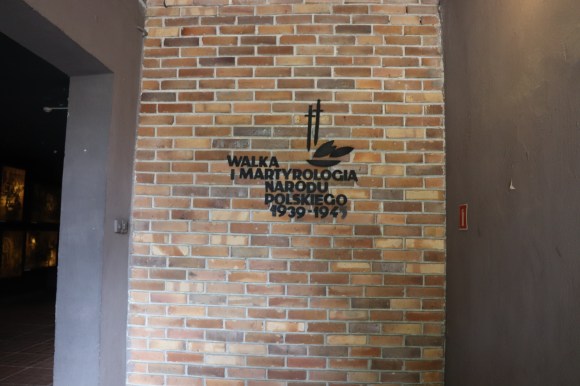
This most recent example of memory politics sheds light on the public debate over contentious history, but it does little to address the politics at play in Poland’s museums and exhibitions. This article will focus on a particular exhibit: “The Struggle and Martyrdom of the Polish Nation 1939-1945” at the Auschwitz-Birkenau Museum and Memorial in Oświęcim. The exhibit, opened to the public in 1985, contains language and terminology reflected presently in Polish memory discourses. This article will outline the exhibit and the media presented within it to bring focus to an overlooked example within the most symbolic memorial in modern history.
An Overview of National Representations Within Auschwitz I
Plans for country-specific exhibits were part of the initial organizational plan for the Museum. The plans, proposed in early 1947, outlined that the three parts the museum would consist of: “a general section showing the story of prisoners in the camp, an international section devoted to the wartime situations of the countries whose citizens were deported to Auschwitz, and a third section presenting the other German concentration camps.” The barracks unused by the museum were “to be placed under the protection of the countries whose citizens died in Auschwitz, or to be used to display information about other Nazi camps” (Auschwitz-Birkenau State Museum).
National exhibitions began opening within thirteen years of the museum’s dedication. The first national exhibits, dedicated to citizens of Czechoslovakia and Hungary, opened to the public in 1960; the Belgian and Danish national exhibitions were unveiled in 1965 and 1968, respectively. The German Democratic Republic (DDR), commonly referred to as East Germany, opened their sponsored exhibit, The Anti-Fascist Movement in Germany, 1933-1945 in 1970. The Hungarian national exhibition opened in 1970 as well, followed by the Bulgarian exhibition in 1977, and the Austrian exhibition in 1978. The national exhibitions of Hungary, Holland, and Italy opened in 1980; the Soviet Union followed them in 1985. The Hungarian National Exhibition was renovated three times over the course of the museum’s history, twice under Communism and a third time in 2004. The exhibition opened in 2004 is the one that is currently on display for visitors.
Following the dissolution of the Soviet Union, countries in the former Communist Bloc began opening their national exhibitions. The first of these, Prisoners from the Czech Lands in Auschwitz and The Tragedy of the Slovakian Jews, were opened in 2002.
Despite the museum’s original intention to reserve exhibitions for countries to represent their citizens, an exhibition on the Roma-Sinti, The Destruction of the European Roma, was opened in 2001. It is the only exhibition that is not sponsored by a recognized state entity (The Destruction of the European Roma exhibition was created by the Documentation and Cultural Centre with the help of the Association of Romani in Poland and other Roma organizations. The exhibit is located in Block 13, within the section containing national exhibitions.)
The national exhibitions have been renovated or retracted during the museum’s history. The original Hungarian exhibit, opened in 1970, was replaced by a new exhibition entitled The Citizen Betrayed: A Remembrance of Holocaust Victims from Hungary; this exhibition opened in 2004. Following the collapse of the Soviet Union, the East German exhibition closed and no exhibition has been planned by unified Germany to replace it.
The Struggle and Martyrdom of the Polish Nation 1939-1945
The Polish national exhibition, located in Block 15 of Auschwitz I, was opened in 1985. The exhibition takes up the whole of Block 15, with minor renovations done in order to manage the flow of the presentation.
Throughout the exhibition, there are instances of language that can be interpreted as unsubstantiated or favoring the concept of collective suffering. The concept of collective suffering is seen in the initial panels describing the invasion by Nazi forces, labeled as “Hitler’s Forces Brought Havoc and Death.” The section highlights six photographs of military personnel captured by the Nazis, including two photographs of mass burial plots. The caption above reads: “As early as the September campaign the Wehrmacht and the SS were already committing many atrocities against prisoners of war. This is the beginning of the terror which soon enveloped the nation and affected all of its citizens.”
As the exhibition continues, a number of the images presented in the displays contain emotional and interpretive language. The previously mentioned section includes a degree of interpretive language; three large photographs taken by the Einsatzgruppen during their campaigns in Ukraine following Operation Barbarossa, provide no citations or credits. Two of the photos were located and are cited in the bibliography; the third photo could not be identified and located for proper citation.
All three photographs include captions at the bottom right-hand corner and read: “Mass executions, such as this in Ukraine, were carried out also on the territory of occupied Poland.” According to the digital archives of Yad Vashem, two of the three photographs were added to Yad Vashem’s collections in 1986 and 1995, respectively. Based on this information, the images were likely added to the Polish exhibition after its initial opening. Emotional language is seen in the caption of a photograph where a group of children is gathered in front of a Nazi guard post in an unspecified location in Warsaw. The caption, without provided context, reads: “Their parents did not return from interrogation. Warsaw.”


The exhibition does include information on the Jewish experience during the occupation, though the section where much of the information presented is under the heading: “Terror, executions, expulsion, deportations to concentration camps and forced labor affected all sectors of the Polish nation.” The section summarizes the concentration of Jews into ghettos and the mass deportations beginning in 1942; a plaque in the section also informs the visitor how, despite the risk of death, 75,000 Jews were saved in Poland with “the overwhelming majority of them (were) rescued by ethnic Poles.” This figure is concerning for a number of reasons; neither the United States Holocaust Memorial Museum nor Yad Vashem has a figure similar to this one referenced in regards to the Holocaust in Poland. Also, the known statistics concerning rescuers in Poland do not match realistically with those given by the exhibit (Using the figure provided by the Polish exhibition, the Righteous honored by Yad Vashem from Poland would have had to rescue ten Jews per person.)
The exhibition includes information on the Warsaw Ghetto Uprising, but the information provided can appear to be conflicting. One caption, which includes many grammatical and spelling errors corrected with a pencil, describes how a “handful of fighters” took part in the Ghetto Uprising; further into the exhibition, a large printed panel gives the historically accurate number range of six hundred to one thousand fighters. Although information published by the United States Holocaust Museum estimates that 17,000 Jews fought with the Polish Home Army during the Warsaw Uprising, none of this is noted in the panels displayed (USHMM).
The final room of the exhibition focuses on the history of Auschwitz from the Polish perspective. Throughout the presentation, a great deal of language suggesting collective suffering is used. One of the first panels states how “there is no other place on the earth where more Jews, Poles, (and) Gypsies perished as a result of criminal method,” while another uses the term “Jewish nation” to describe the millions of Jews deported from occupied territories. The latter panel also makes clear distinctions between ethnic Poles and other prisoners deported from across Europe, using the term “representatives” to describe non-Jewish prisoners.
The most distinctive feature of the exhibit comes before one exits the block. From the staircase used to enter the room, the entire left-hand wall is lined with photographs of Auschwitz prisoners. In front of the photographs, wire mannequins dressed in striped prisoner uniforms arranged in hunched marching positions. The uniforms, which include women’s dresses, do not display prisoner numbers or the color-coordinated triangles used to identify prisoners. No Star of David patches are present in the display.

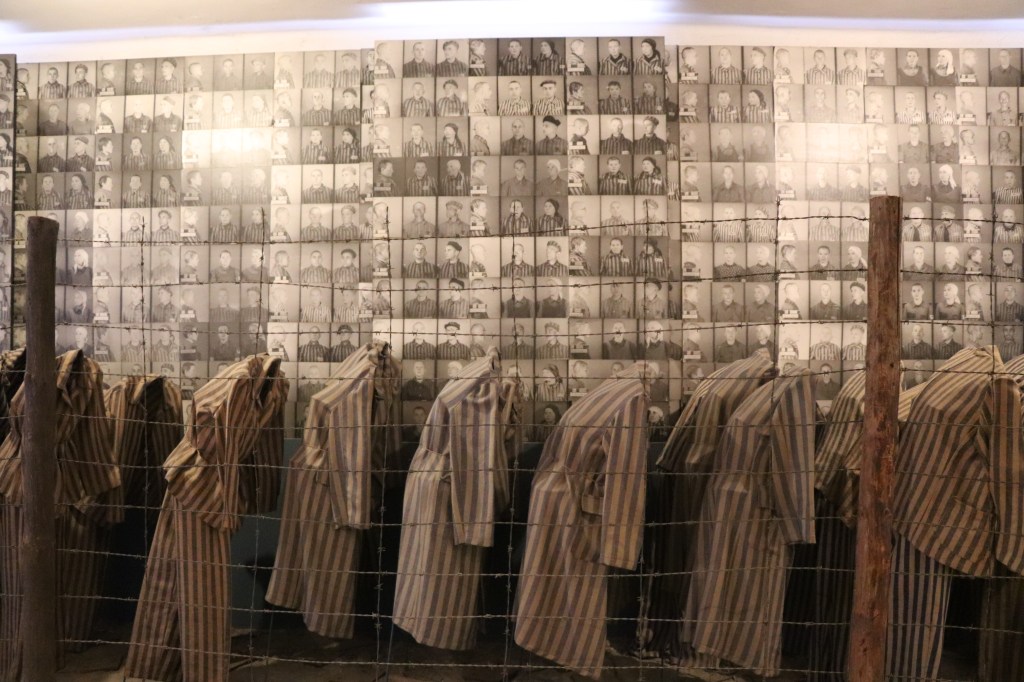
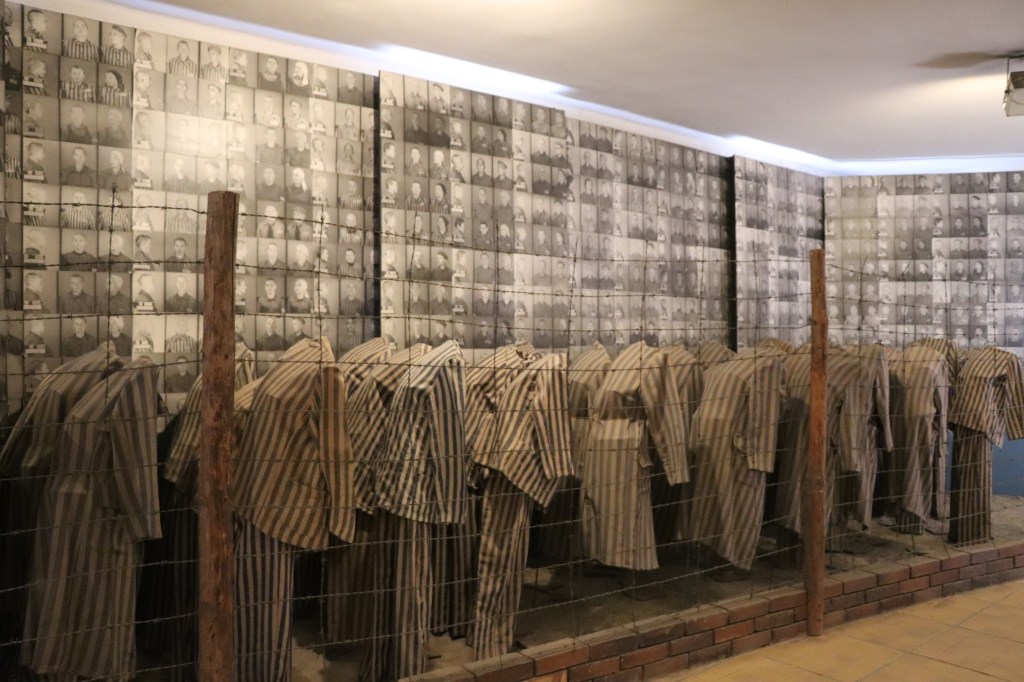
The lack of triangles on the uniforms gives the visitor no indication as to the identity of the prisoners being represented; therefore, the lack of a Yellow Star and/or a triangle with a “P” stitched into its center misleads visitors as to the identity of the prisoners being represented with the mannequins and striped uniforms. In the concentration camp system, non-Jewish prisoners were designated by color-coded triangles with letters or words stitched onto the triangle. The triangle stitched with a “P” designated Polish prisoners.
Conclusion
Poland’s history during the German occupation is a debate that has challenged its identity since the end of the war. Recent historical studies, most notably Jan Gross’s Neighbors: The Destruction of the Jewish Community in Jedwabne, Poland, and Fear: Anti-Semitism in Poland After Auschwitz have brought into question the self- perceived images of Poles as rescuers, resisters, and martyrs. Successful grassroots initiatives, the most notable being the Jan Karski Association in Kielce, have made strides in achieving an environment for reflection and reconciliation in communities faced with this troubled history. The special circumstances of Poland’s relationship to Auschwitz raise the question of representation and where a line should or should not be drawn between distinctions of ethnic Poles and Polish Jews.
In 2016, the Auschwitz Museum announced that a new exhibition on Polish victims was being planned and that it would replace the exhibition mentioned in this article. The opportunity to redesign the Polish exhibition comes at a time when Poland’s history, and the institutions that represent that memory, have found themselves in the crosshairs of historical fact and nationalist revisionism. The new exhibition will surely contain more recent scholarship and more contextual information, but whose benefit it will serve can only be determined by those overseeing the exhibition’s script. Auschwitz, which has always stood as a memorial to the victims of the Holocaust, may become a battleground between history and national memory that would prove consequential for generations. To quote historian Timothy Snyder in his commentary on the government’s closure of the Museum of the Second World War in Gdańsk: “in some measure at least, how the rising generations of Poles see themselves, democracy, and Europe will depend on whether they can have ready access to their country’s complicated experience in World War II” (Snyder 5).
Works Cited
Auschwitz-Birkenau Memorial and Museum. “Memorial Timeline.” History of the Memorial. Accessed August 1, 2018. http://auschwitz.org/en/museum/history-of-the-memorial/memorial-timeline/
Auschwitz-Birkenau Memorial and Museum. “The First Years of the Memorial.” History of the Memorial. Accessed August 1, 2018. http://auschwitz.org/en/museum/history-of-the-memorial/the-first-years-of-the- memorial/.
McMackin, Theresa. Auschwitz I Polish Exhibition. 14 July 2018. Photographs 1-185.
Santora, Marc. “Poland’s President Supports Making Some Holocaust Statements a Crime.” The New York Times. February 6, 2018. http://www.nytimes.com/2018/02/06/world/europe/poland-holocaust-law.html.
Snyder, Timothy. “Poland vs. History.” NYR Daily, The New York Review of Books. March 7, 2018, http://www.nybooks.com/daily/2016/05/03/poland-vs-history-museum-gdansk/.
United States Holocaust Memorial Museum. “Warsaw.” Holocaust Encyclopedia. Accessed August 3, 2018. https://encyclopedia.ushmm.org/content/en/article/warsaw.
United States Holocaust Memorial Museum. “Warsaw Ghetto Uprising.” Holocaust Encyclopedia. Accessed August 3, 2018. https://encyclopedia.ushmm.org/content/en/article/warsaw-ghetto-uprising.
Yad Vashem. Vinnitza, Ukraine, German Soldiers Watching an Einsatzgruppen Soldier Murder a Jew, 07/1941. Digital Image Yad Vashem, 21 Mar. 1995. Web. 3 Aug 2018. https://photos.yadvashem.org/photo-details.html?language=en&item_id=30622&ind=0.
Yad Vashem. The Untold Stories: The Murder Sites of the Jews in the Occupied Territories of the Former USSR Photo: Ivangorod, Ukraine, A German Policeman Aims His Rifle at a Woman and Her Child, 1942. Accessed August 3, 2018. https://www.yadvashem.org/untoldstories/database/homepage.asp
© The Museum of Jewish Heritage, 2019
This article is reprinted with permission. It originally appeared in Reflections: Auschwitz Jewish Center 2018 Alumni Journal, ©Auschwitz Jewish Center
Established in 2000, the Auschwitz Jewish Center (AJC), a proud member of the Museum of Jewish Heritage—A Living Memorial to the Holocaust family, is a cultural and educational institution located in Oświęcim,Poland.
The only Jewish presence in the vicinity of Auschwitz, the AJC is comprised of three buildings: the Chevra Lomdei Mishnayot Synagogue; the adjoining Kornreich House, which once housed a Jewish family and today houses a Jewish Museum and educational programs; and the 100-year-old Kluger Family House, which belonged to the last Jewish resident of Oświęcim, Szymon Kluger, after WWII.
The AJC offers immersive study programs on the Holocaust, Jewish history and heritage, and diversity education—serving students from around the world, including the AJC Fellows Program in which I participated.

 The Existential Academic: A Blog by Theresa McMackin
Leave a comment